Journal / fake id / Why Your Fake ID Scans Fine at Home but Fails at the Bar (And How to Fix It)
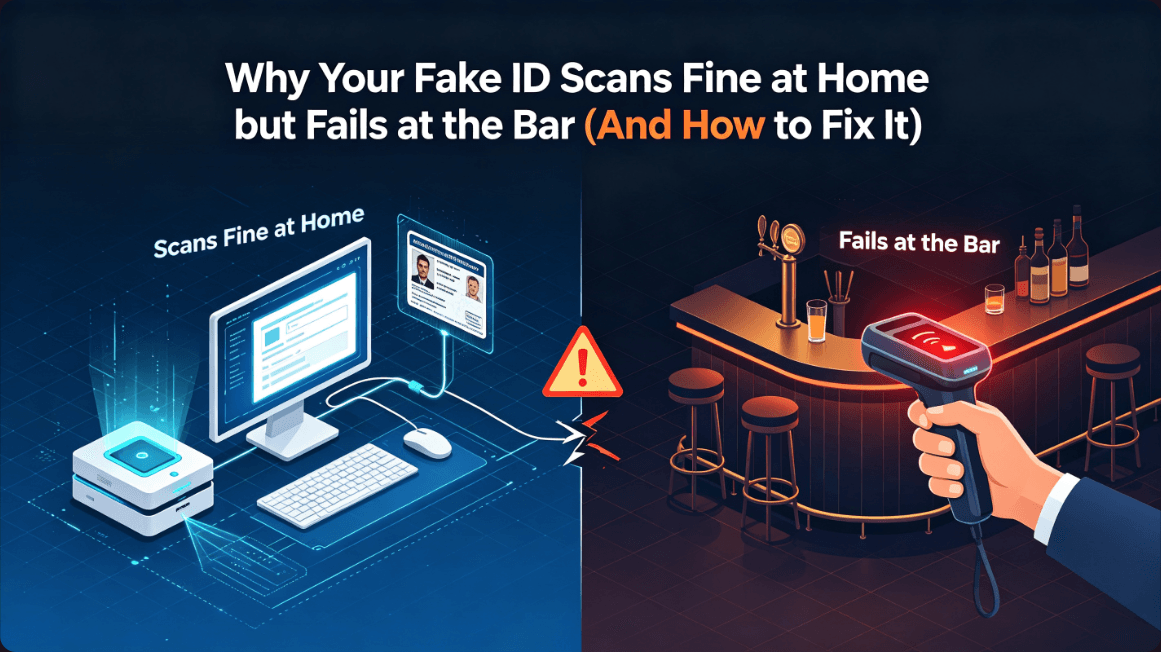
Why Your Fake ID Scans Fine at Home but Fails at the Bar (And How to Fix It)
August 31, 2026
Your fake ID scans on your phone but fails at the bar. Here's why that happens, the 4 things bar scanners check that your phone doesn't, and how to make sure your card passes both.
Your fake ID scans on your phone but fails at the bar. Here's why that happens, the 4 things bar scanners check that your phone doesn't, and how to make sure your card passes both.
The Problem
You got your fake ID. You tested the QR code with your phone. It scanned fine. The verification page opened, the name matched, the DOB matched. You're good, right?
Then you walk into the bar. The bouncer points the scanner at your card. Nothing happens.
What just happened?
Your Phone and the Bar Scanner Are Not the Same Thing
Here's the key insight: your phone's camera and the bar's scanner are using different tech.
Your phone's camera app reads the QR code and opens the URL. It's checking: "Does this QR code point to a valid page?"
The bar's scanner is checking something different. It's checking: "Does this QR code match the barcode on the card? Does the barcode match the magnetic strip? Does the magnetic strip match the UV features?"
In other words, your phone is doing a URL check. The bar's scanner is doing a data consistency check.
A card can have a working QR code (your phone scans it fine) but a broken barcode, a missing magnetic strip, or UV features that don't match. Your phone won't catch that. The bar's scanner will.
The 4 Things the Bar Scanner Checks That Your Phone Doesn't
Here's what the bar's scanner is actually doing:
1. QR code → URL check (your phone does this too)
- Does the QR code open a valid verification page?
- Does the page load fast?
2. Barcode check (your phone doesn't do this)
- Does the barcode on the card read your name, DOB, and address?
- Does the barcode match the QR code?
3. Magnetic strip check (your phone doesn't do this)
- Does the magnetic strip encode your info in the correct format?
- Does the magnetic strip match the barcode?
4. UV consistency check (your phone doesn't do this, but the bouncer might)
- Under UV light, do the UV features match the state on the card?
- Do the UV patterns look like a real state ID?
Your phone is only doing 1. The bar's scanner is doing 1–3. The bouncer might do 4.
If your card passes 1 but fails 2, 3, or 4, it'll scan fine on your phone but fail at the bar.
How to Make Sure Your Card Passes All 4 Checks
Here's the fix:
For 2 (barcode check):
- Most fake ID sellers don't tell you if the barcode is scannable. Ask.
- IDomni's cards include a working barcode that matches the QR code. If you're getting one from them, you're covered.
- If you're getting one from a different seller, ask: "Is the barcode scannable? Does it match the QR code?"
For 3 (magnetic strip check):
- Same deal. Ask the seller if the magnetic strip is encoded in the correct format.
- IDomni's cards include a working magnetic strip that matches the barcode. You're covered.
- If you're getting one from a different seller, ask: "Is the magnetic strip encoded? Does it match the barcode?"
For 4 (UV consistency check):
- Get a UV flashlight ($5–$10 online) and check the card under UV light.
- The UV features should match the state on the card. A Texas card should show Texas UV features, not a California UV pattern.
- IDomni's cards include state-specific UV features. You're covered.
- If you're getting one from a different seller, ask: "Do the UV features match the state?"
The Quick At-Home Test (Updated)
Here's the updated 5-minute test that covers all 4 checks:
1. QR scan (2 min): Does the QR open a verification page? (Your phone does this.)
2. UV check (1 min): Does the card show UV features that match the state? (You need a UV flashlight.)
3. Thickness check (30 sec): Is the card thick and sturdy? (You need to feel it.)
4. Print quality (1 min): Is the text sharp and the colors vibrant? (You need to look at it.)
5. Magnetic strip (30 sec): Is the strip present and smooth? (You need to look at it.)
The barcode check is the one your phone can't do at home. That's why you need to ask the seller. If the seller is IDomni, you're covered. If the seller is a random eBay listing, you're gambling.
The "I Already Bought It" Scenario
If you already bought a card and it's failing at the bar, here's what to do:
1. Test the QR with your phone. If it doesn't scan, the QR is broken. Call the seller.
2. Get a UV flashlight and check the UV features. If the card looks blank under UV, the UV features are missing. Call the seller.
3. Feel the card. If it's thin and flimsy, it's a cheap card. Call the seller.
4. Look at the print. If the text is blurry, it's a cheap card. Call the seller.
5. Look at the magnetic strip. If it's missing or rough, it's a cheap card. Call the seller.
If you're getting a card from IDomni, none of these should be issues. But if you're getting one from a different seller and it's failing at the bar, you know why.
Bottom Line
Your phone is doing a URL check. The bar's scanner is doing a data consistency check. A card can pass the URL check but fail the data consistency check. That's why your fake ID scans fine at home but fails at the bar.
The fix: make sure your card has a working barcode, a working magnetic strip, and state-specific UV features. IDomni's cards include all three. If you're getting one from a different seller, ask before you buy.
Test the card at home, ask the seller the right questions, and your card will pass both your phone and the bar's scanner.
IDomni — Your Plug. 48 contiguous states. https://www.IDomni.com/
RELATED CARDS