Journal / best fake id / Why a Phone Photo of Your ID Never Works (And What Does)
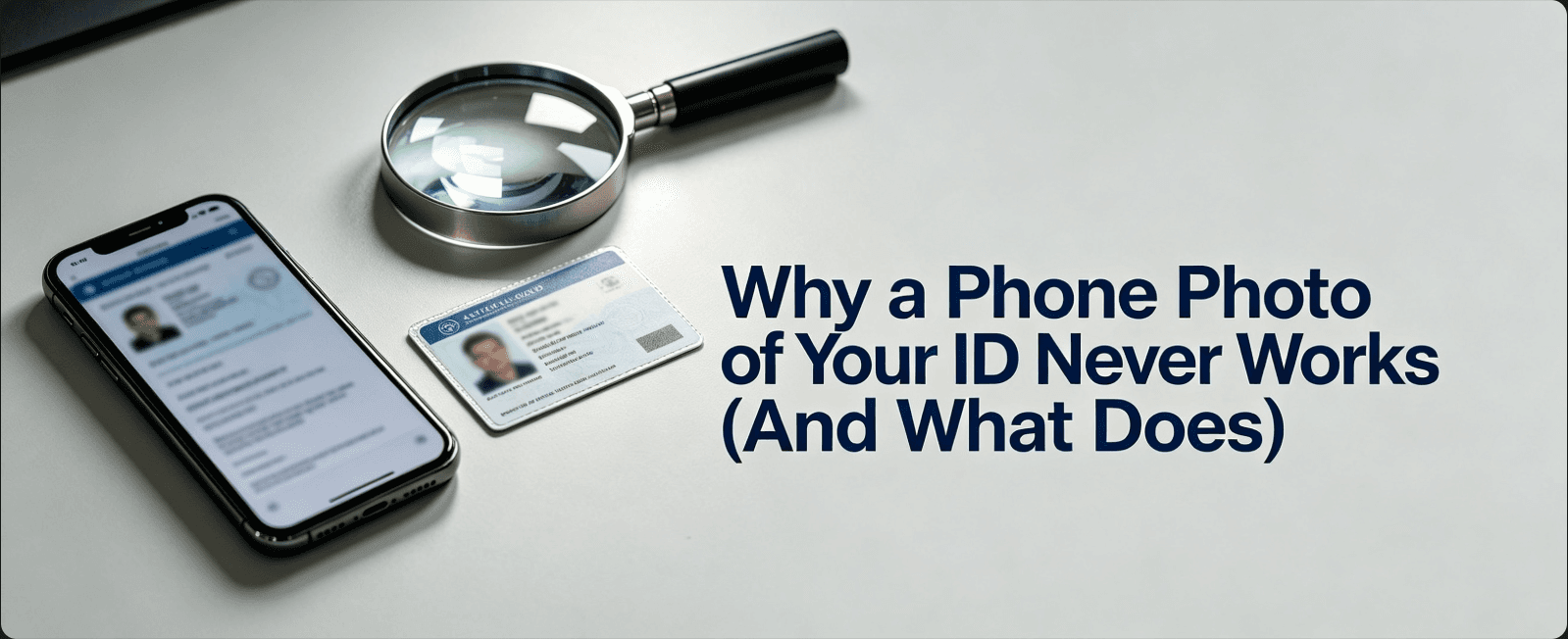
Why a Phone Photo of Your ID Never Works (And What Does)
August 27, 2026
The most expensive move in college bar life is not a bad card. It is the phone.
You are at the door. The bouncer says ID. You pull out your phone, unlock it, scroll to your camera roll, find the picture of your license, and hold it up like it means something. And ninety percent of the time, it does not.
Here is why, and it is more technical than most people think.
Reason one: the glare. A phone screen is a light source. It reflects the bar lights, your own face, the neon sign three blocks away. The bouncer is trying to read a small glowing rectangle in a dark bar, and the glare is bouncing right off it. He squints. You can see him squint. That squint is the beginning of the end. A real ID is matte or glossy laminate, and it reflects light in a specific, predictable way. A phone screen reflects everything at once. That is the first tell.
Reason two: the font. Real IDs use specific fonts with specific spacing. On a phone screen, the font gets interpolated, blurred by the display, and rendered by whatever scaling your phone does. You zoom out and it looks fine to you, because you are used to it. But the bouncer who has looked at a thousand real IDs knows exactly how the text is supposed to look, and the text on your phone does not. The letters are a little too sharp, a little too blurry, a little too evenly spaced. It is subtle, but it is there, and it is the reason the bouncer asks you to put it on the counter or hold it still.
Reason three: no magstripe. This is the big one, and it is the reason phones have basically stopped working at good bars. The phone has no magnetic stripe, no barcode, no RFID chip. If the bar has a scanner, and in 2026 the good bars do, the phone has nothing to give the scanner. The bouncer pulls you aside, holds the phone up to the scanner, and the scanner reads nothing. In that moment, you are not holding an ID. You are holding a phone. And everyone at the door knows the difference.
Reason four: the bouncer has seen a million phones. This is the one nobody talks about. The bouncer does not think your phone photo is a photo of an ID. He thinks your phone photo is the thing that 80 percent of fakes come in as. In his head, phone photo and fake ID are the same category. The second you pull out your phone, you have already lost half the battle, before he even looks at the screen. He is not looking at your ID. He is looking at the category of person who pulled out a phone, and that category has a high failure rate.
So what actually works? Let me walk through it.
A real physical ID, obviously. If you are 21, this is your best card. No debate.
A good physical fake. A card with real laminate, a working magstripe, a barcode that scans, and a print date that makes sense. This is the card that passes at good bars. The key word is good. The cheap printout card with no magstripe is just a more expensive phone photo. It passes the first check and fails the scanner.
A passport. Surprisingly, a passport still works at most bars, because most bars do not know how to check a passport well. But it is a heavier card to carry, and some places specifically ask for a driver's license, so it is not always the move.
What does not work? The phone photo. The screenshot. The picture you printed at home and laminated in a bathroom. The my brother has my ID at home story. The bouncer has heard them all, and he is tired.
Here is the thing about the phone photo myth. It persists because it works sometimes. At the dive bar, with the friendly bartender, on a slow Tuesday, the phone photo gets you through. And you remember that night. You do not remember the fifteen nights it did not. So you keep doing it. And then one night, at the good bar, with the scanner, with the real bouncer, it fails, and you are standing in the doorway with your phone in your hand, and your whole group is watching.
The fix is simple. Get a real card. Not a better photo. A card. Something with a magstripe, something with a laminate, something that scans. A service like IDomni makes cards that do exactly that. They cover all 48 states, ship fast, and the cards are built to pass the scanner, which is the part that matters. A new face with shipping comes out to around $120, which is a one-time cost, and after that you are never standing in a doorway with a phone again.
If you are still not sure, email [email protected] or check out IDomni.com and see what they have. But do it before the night you need it. That is the whole lesson. The phone photo is the myth. The card is the fix.