Journal / how to get a fake id / The Art of the ID Check: Bar Etiquette When You're Not 21
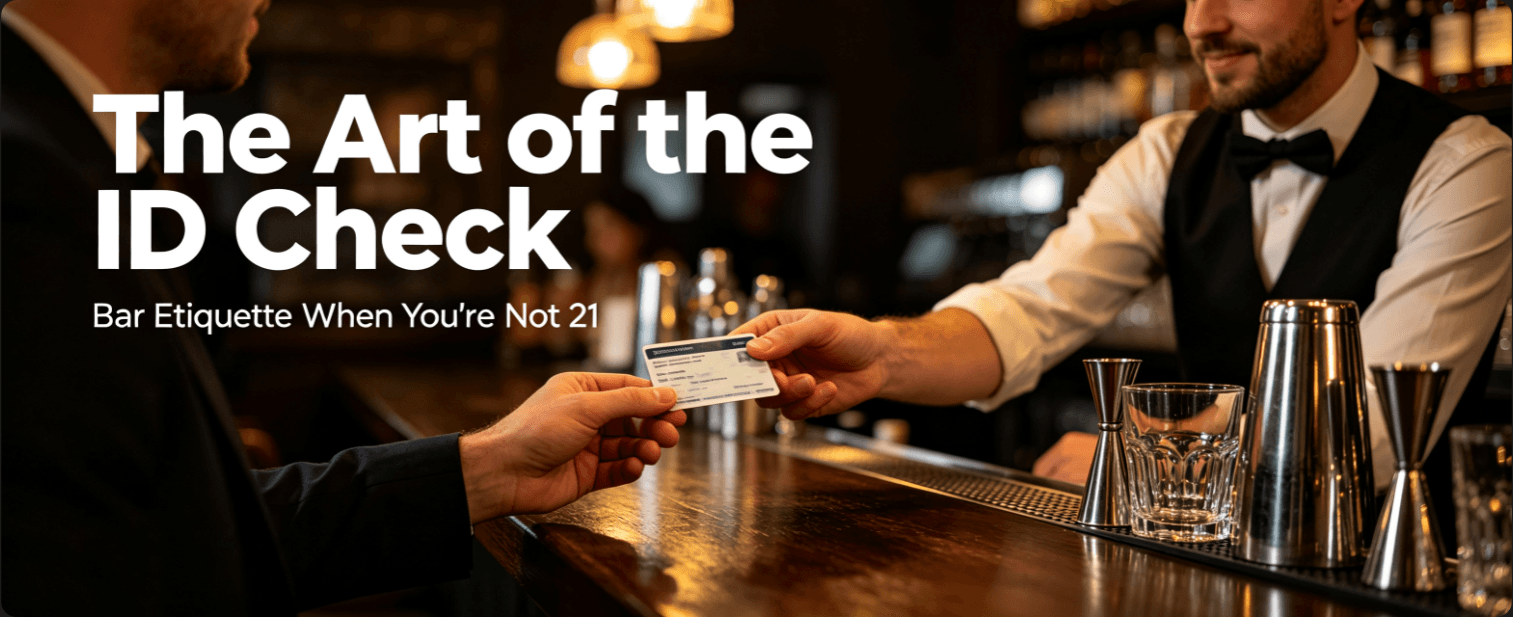
The Art of the ID Check: Bar Etiquette When You're Not 21
September 9, 2026
The bartender asks. Your heart rate goes up. Now what? The card is the easy part. The behavior is where people get caught.
Here's something nobody tells you: most people don't get caught on the card. They get caught on the behavior. The card was fine. The scan read. The photo matched. But the person who presented it did something that made the bartender look twice. A hesitation. A flip of the wrist. A "so you're 21?" that came out too eager. The card was 21. The person acting 21 was not.
Once you understand that the check is a performance, not a transaction, you can play it well. Here's the playbook.
Before You Reach: The Mindset
The bartender is checking your ID because the job requires it. It's not personal. You're not on trial. You're a customer completing a step. The people who get caught are usually the ones who treated the check as an interrogation and responded with the energy of a suspect. The people who get through treat it as a formality.
The core rule:
Act like you've done this a hundred times. Because for the purposes of the check, you have. The 21-year-old next to you has a real ID and doesn't think about it. Be that person. Boring is the goal. Boring is 21. Boring walks through.
The Physical: How to Present the Card
When the bartender says "can I see your ID?", the physical presentation matters more than you'd think. Here's what to do:
✓ Reach with your dominant hand, calmly. Pull the card out of your wallet or pocket smoothly. No fumbling. No "uh, is it in here?" If you need a second to find it, it's fine to say "one sec" naturally — a real person also fumbles their wallet. But don't make a production of it.
✓ Hand it over with the photo facing up, toward the bartender. Don't hand it over face-down or rotated. Photo up, name readable. That's what the bartender expects and wants to see.
✓ Don't hover over it. Hand it over and let go. A subtle tell is the person who hands over the card but keeps their hand on it, or pulls it halfway back, or watches it intensely as the bartender handles it. A confident 21-year-old hands it over and relaxes. You can watch, but you're not guarding it.
✓ If they run it through a scanner, hold still and let them. Don't tug it back while it's in the reader. Let the swipe complete. Don't narrate: "okay, and now it's gonna read it, and then..." Just let the machine do its thing.
The Verbal: What to Say (and Not Say)
Words matter. Here's the guidance:
⚡ Keep it minimal. "Here you go." "Sure." "Yep." These are all fine. You don't need to fill the silence. A beat of quiet while they check the card is completely normal. Don't rush to fill it.
⚡ Don't over-explain your age. You don't need to say "I'm 21, I just turned 21 two months ago, actually I'm more like 21 and a half if you count the months, but I mean I'm 21 in the way that..." Just "21" if asked. Or let the card speak.
⚡ If they ask "how old are you?", answer plainly. "21." Short. Clean. You can add "I just turned 21" if you want a little color, but don't launch into a monologue.
⚡ If they ask "are you 21?" and you are (on the card), say "yes" with appropriate conviction. Not "uh, yeah, I guess so?" Not "well, I mean, I'm 21 in the sense that, you know, the card says 21, so, yeah." Just "yes."
⚡ Maintain conversational tone, not nervous energy. Talk like you're talking to a person you'd talk to at a restaurant about the menu. Normal volume, normal pace, normal eye contact. Not a whisper. Not a rapid-fire delivery. Normal.
The Eye Contact and Body Language
While the bartender examines the card, your face and body are part of the signal. Here's what to keep in mind:
✓ Maintain relaxed eye contact with the bartender. Don't stare into space. Don't avoid their eyes entirely. Look at them naturally, the way you'd look at anyone you're talking to. A slight, relaxed smile is okay if it feels natural. A forced grin is not.
✓ Keep your shoulders down and your posture relaxed. Tension shows. If your shoulders are up by your ears, your body is saying "nervous" even if your face says "fine." Consciously let your shoulders drop. Stand or sit like you're comfortable. Because you are. You're at a bar. You're having a drink. You're comfortable.
✓ Don't check your phone while they're looking at your card. It reads as distraction or "looking for backup." Let the moment complete. Look at the bartender, let them do their check, and when they hand the card back, take it, put it away, and continue the evening.
✓ When they hand the card back, take it, tuck it away, and continue. No need to make a scene. No need to say "thanks, cool, yeah." Just take it, pocket it, and get back to the moment — your drink, your friends, the night. The check is done. The evening is yours.
Common Myth
"If you're calm, they'll assume your ID is real." Partially. Calm helps, but it's not a guarantee. The bartender's job is to check, and a calm person with a bad ID still gets a "hmm" if the card looks off. And a nervous person with a great ID usually gets a "you're good, thanks" because the card read clean and the scan confirmed it. Calm + good card = smooth. Calm + bad card = they still find the issue. Nervous + good card = probably fine, the scan is the real check. The behavior sets the tone, but the card and the scan decide the outcome. Manage the behavior so the card gets a fair read.
When the Check Goes Slightly Off
Sometimes the moment isn't perfectly smooth. The bartender seems to look at the card a little longer. Or they ask a follow-up question. Here's how to handle the slightly off moments:
If they study the card longer than expected
Stay calm. They might be checking the expiration date, or the photo, or the state. You don't need to narrate what you think they're checking. Let them finish. If they ask about something on the card, answer plainly.
If they ask "where are you from?" or "what state is this from?"
Answer consistently with the card. If the card is a California ID, being consistent about California is the move. You don't need a whole backstory. "California" or "I'm from California" is enough. If you actually are from that state, it's easy. If you're not, just go with the card's state for the purpose of the evening — you don't owe the bartender your travel history.
If they say "hmm" or "let me look at that"
Don't panic. "Hm" can mean a lot of things — they're checking the expiration, they're looking at the photo, they're just being thorough. Stay relaxed. If there's a real issue, they'll tell you. If it's just a moment of examination, let it complete. The "hmm" is not a verdict. It's a process.
Recovery move:
If the moment gets slightly awkward, a light, natural comment can reset it. "You guys check a lot of IDs, I'm used to it by now" is a line that normalizes the situation and shows you're not rattled. It tells the bartender "this is normal for me, I'm not a first-timer." That's the energy of a 21-year-old who's been doing this for a year. Own the normalization.
The Exit: Taking the Card Back
When the bartender hands the card back, the take-back is also part of the performance. Here's the standard:
✓ Take it naturally, no dramatic reception. Receive the card like you'd receive anything handed back to you — your jacket, your coat, your friend's phone. A hand, a close, a pocket. That's the whole sequence. No "oh, thanks, yeah, cool." No "thanks." Just the physical receipt.
✓ Tuck it away without examining it in front of them. Don't flip it over, don't look at the back, don't study the photo as you pocket it. Just close the wallet or drop it in the pocket. The card is yours and it's going home. The bartender doesn't need a second viewing.
✓ After it's pocketed, resume the evening. The moment is complete. Turn back to your friends, your drink, the room. The ID check was an interruption, and now it's over. Your attention goes back to the night. The bartender can return to the bar. You return to the moment. That's the full cycle.
The Full Sequence: A Reference Walkthrough
Here's the entire interaction, start to finish, as a reference. This is the "good" version — the one that reads as a 21-year-old completing a routine:
1. The prompt: Bartender: "Can I get your ID, please?" You: a nod, a "sure" or "of course," and your hand going to the wallet. The motion is smooth, not a search. The card is found and pulled with the photo side up.
2. The handover: You extend the card, photo toward them, and let your fingers release. You don't hover. The bartender takes it. For a moment, the card is in their hands and you're watching them look at it. Your face is relaxed. Your shoulders are down. You're not scanning the room for witnesses. You're looking at the bartender, and that's it.
3. The scan (if there is one): The bartender takes the card and runs it through the reader. You hold still while they do it. The swipe is quick. Then the card comes out of the reader and is back in their hand. They glance at it one more time. That's the full physical process. No need to narrate any of it.
4. The decision: The bartender finishes their check. They decide. In the good case, they nod or say "you're good" or "thanks" and hand the card back. In that moment, your face can show a small, natural acknowledgment. Not a huge smile. Not a relief that's obvious. Just a "yeah, thanks" energy. The moment is resolving and you're part of the resolution.
5. The take-back: You receive the card. You close the wallet or drop the card in your pocket. The motion is the same as any other "putting something away." There's no ceremony. The card is back where it was and now it's out of the interaction.
6. The resumption: You turn to your friends or back to the bar or to your drink. The evening resumes. The ID check was a small interruption in the flow of the night, and now the flow is back. You're at the bar. You're 21. You're having a drink. That's the story, and it's a good one.
Why the IDomni card fits the performance:
A good card makes the behavior easier. If the card is the real thing — the photo is yours, the scan reads, the hologram is right — then the performance is almost effortless. You don't have to compensate for a weak card with extra smoothness. The card does its job, and you just have to be you. An IDomni card, with the right photo and a clean scan, means your only job is to act normal. And if you're normal, you're 21. And if you're 21, you're in.
The card is half the check. The behavior is the other half. Get both right and the evening is yours.
Get a Card That Does Its Part →
The card says you're 21. Your behavior has to prove it. The scan is the fact. The performance is the frame. Get the frame right and the fact stands.
📍
·
·
YOUR PLUG · IDomni